Water Softener Installation, Repair & Service in Caledon
Caledon's municipal water tests hard to very hard, and most rural wells are harder still. ProFlow installs, repairs, and services water softeners across Bolton, Caledon East, Caledon Village, Palgrave, Alton, and every concession road in between — plus iron filters and UV systems for well water.
Hard Water Is a Fact of Life in Caledon — Here Are the Numbers
If you've ever scraped white crust off a kettle, fought with a cloudy shower door, or watched a brand-new faucet lose its shine in a year, you already know Caledon water is hard. The reason is geology: most of Caledon's municipal supply comes from groundwater wells drilled into limestone and dolostone, and that rock loads the water with dissolved calcium and magnesium. Water chemists call anything above 120 mg/L "hard" and anything above 180 mg/L "very hard" — and much of Caledon sits well past that second line.
At ProFlow Plumbing & Drain Solutions Caledon, water softener work is a daily part of what we do, because hard water is behind so many of the other calls we get — scaled-up water heaters, clogged aerators, failed cartridges, and dishwashers that never quite rinse clean. Whether you're on Peel Region water in Bolton or a private well off Charleston Sideroad, we test first, explain what the numbers mean, and recommend the right hard water treatment for your home.
Measured Hardness of Caledon's Municipal Water (2025 Peel Region Reports)
These figures come straight from Peel Region's 2025 annual drinking water quality reports for treated water. Hardness is expressed as mg/L of calcium carbonate and in grains per US gallon (gpg), which is the unit softener manufacturers use for sizing.
Bolton & Mayfield West
120–130 mg/L
7.0–7.6 gpg — hard. Lake Ontario water via the South Peel system.
Caledon Village, Mono Mills & Skywood
190–280 mg/L
11.1–16.4 gpg — very hard. Groundwater wells.
Palgrave
240–250 mg/L
14.6–15.2 gpg — very hard. Groundwater wells.
Caledon East & Alton
280–360 mg/L
16.4–21.0 gpg in Caledon East; 320–330 mg/L (18.7–19.3 gpg) in Alton — among the hardest municipal water in the GTA.
Sources: Region of Peel 2025 Annual Drinking Water Quality Reports — South Peel Drinking Water System (Bolton & Mayfield West), Caledon Village & Alton Drinking Water Systems, and Palgrave & Caledon East Drinking Water System. Figures are for treated water; private wells are not covered by these reports, so we test those on site.
For comparison, Peel's own operational target for softened lake water is 80–100 mg/L. A home in Caledon East can be seeing three to four times that — which is why water softener service here isn't a luxury upgrade, it's basic protection for your plumbing.
Not sure what's coming out of your taps? Call (289) 236-7045 and we'll test hardness and iron on site, then explain the results in plain language.
Signs Your Caledon Home Needs a Water Softener
Hard water rarely announces itself with a single dramatic failure. It works slowly, and by the time you notice, it has usually already shortened the life of something expensive. These are the symptoms that bring Caledon homeowners to us most often.
White Scale on Fixtures & Glass
Chalky deposits on faucets, shower heads, and glass doors are calcium carbonate left behind as water evaporates — the same scale forming inside your pipes.
Water Heater Rumbling or Failing Early
Sediment cooking at the bottom of the tank is hardness minerals. If your water heater is noisy or on its second replacement, hard water is usually the reason.
Dry Skin, Dull Hair, Stiff Laundry
Soap doesn't lather properly in hard water and leaves a film behind. Towels feel rough, colours fade faster, and you use far more detergent than you should.
Spotty Dishes & Appliance Breakdowns
Dishwashers, coffee makers, and washing machine valves clog with scale. Many appliance warranties specifically note hard-water damage as a cause of early failure.
Low Flow at Showers & Faucets
Scale narrows aerators, cartridges, and eventually the pipes themselves. If pressure keeps dropping at one fixture after another, the water is the culprit.
Orange Staining or a Rotten-Egg Smell
Rust-coloured stains in tubs and toilets point to iron; a sulphur smell means hydrogen sulphide. Both are common on Caledon wells and need more than a softener alone.
Water Softener Installation, Repair & Service Under One Roof
Whether you need a first softener for a new build in Southfields Village, a repair on a unit that stopped regenerating, or an annual check on a system you've had for years, one local number covers it.
Water Softener Installation in Caledon
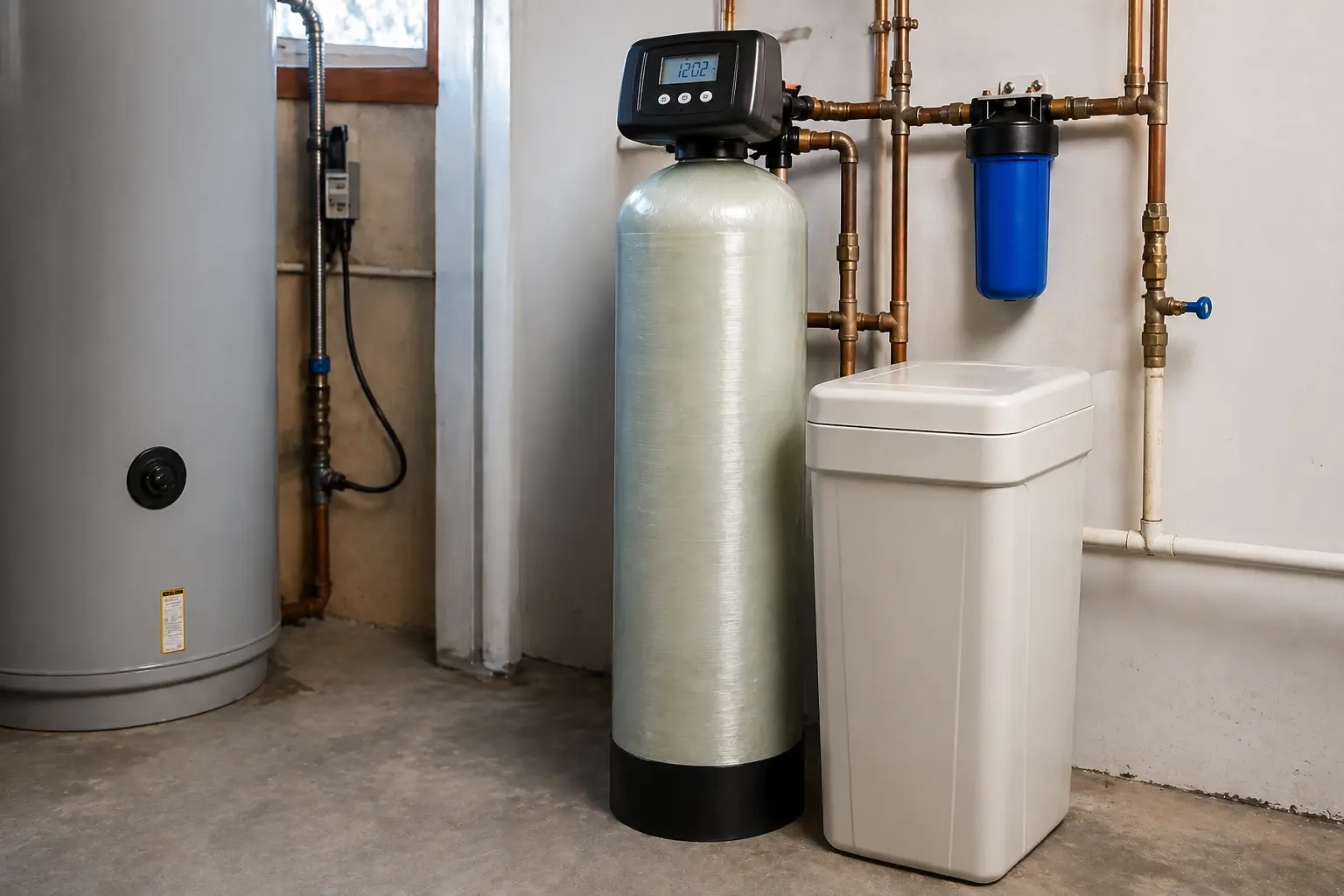
A softener only works if it's sized to your water and your household. We start with a hardness and iron test, count bathrooms and occupants, and then select a grain capacity that regenerates efficiently without wasting salt. Installation includes a bypass valve so you can isolate the unit, a dedicated drain line for regeneration, and — where you want it — a hard-water tap at the kitchen sink or an outdoor spigot for the garden. A Caledon East family we worked with recently had been through two water heaters in eight years; after we installed a properly sized softener and flushed the new tank, the scale problem stopped at the source.
Every install includes
On-site hardness & iron test
Grain-capacity sizing for your household
Bypass valve & proper drain connection
Optional hard-water line for outdoor taps
Programming, salt loading & walkthrough
Water Softener Repair in Caledon
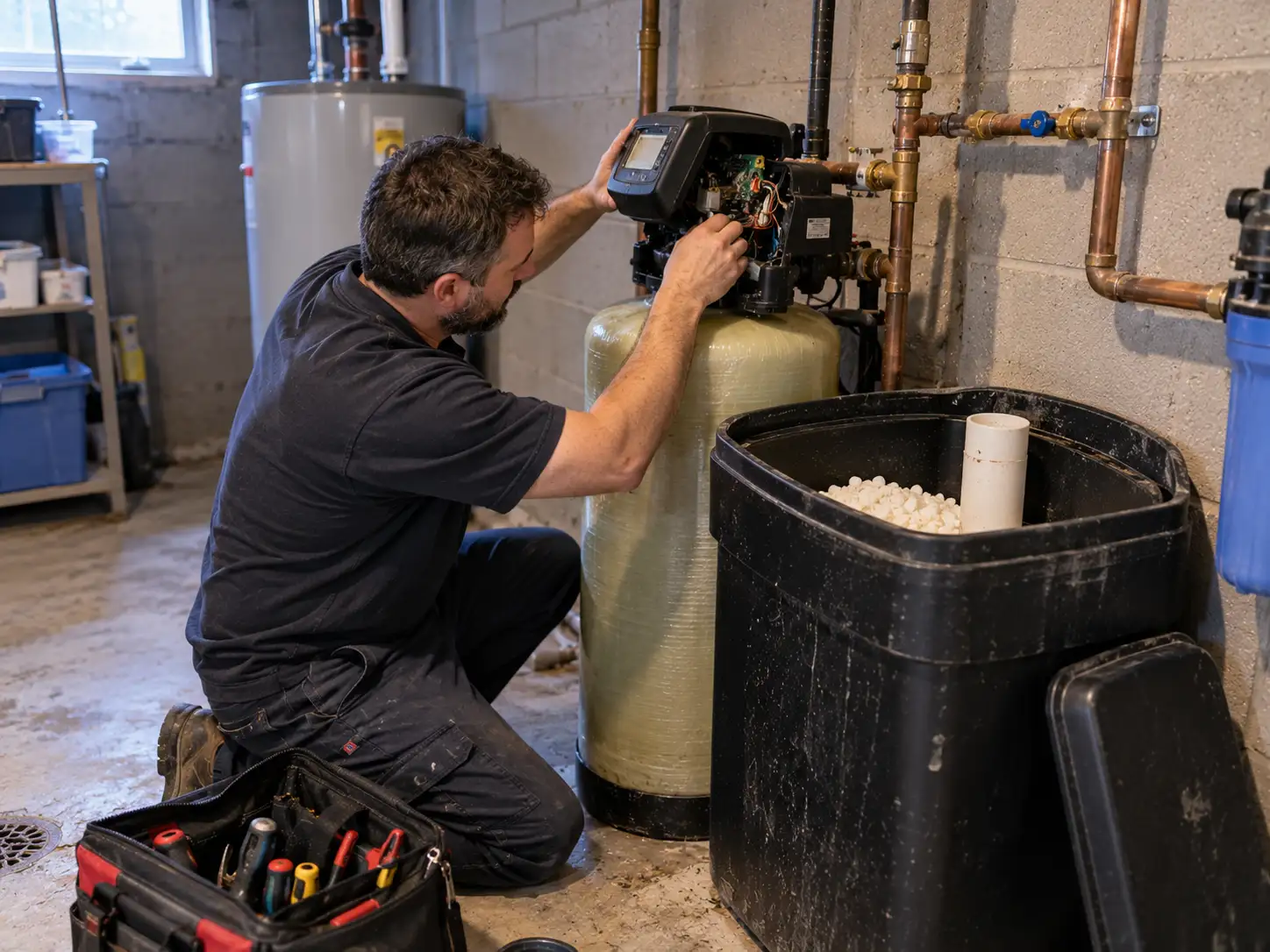
The most common call we get is simple: "The softener's running, but the water's hard again." Usually that means a salt bridge in the brine tank, a stuck float, a control valve that isn't drawing brine, or resin that has finally given out. Other times it's a unit stuck in a regeneration cycle, running water to the drain for hours — on a well, that can also run your well pump far harder than it should. We diagnose on site, carry common valve parts, and tell you plainly whether a repair or a replacement is the better use of your money.
Common repairs
Salt bridges & brine tank cleaning
Control valve, motor & timer faults
Stuck in regeneration / constant draining
Resin replacement & iron-fouled beds
Leaks at bypass, fittings & drain line
Annual Water Softener Service
Softeners are low-maintenance, not no-maintenance. Once a year we re-test your water (well chemistry drifts with the seasons), confirm the unit is actually removing hardness, clean the brine tank and injector, check the drain and bypass for leaks, and re-program the regeneration settings if your household has changed. On iron-bearing wells we also treat the resin bed so iron doesn't slowly choke it. It's a short visit that protects the softener and everything downstream of it, including the water heater it's there to shield.
Every service visit includes
Hardness test before & after the softener
Brine tank & injector cleaning
Resin cleaning on iron-bearing wells
Regeneration settings re-programmed
Leak check on bypass, fittings & drain
Well Water Softeners & Iron Filters for Rural Caledon
Outside the serviced villages, most of Caledon runs on private wells — and well water brings its own chemistry. Hardness is usually higher than the municipal figures above, and it's often joined by dissolved iron, which stains tubs and laundry orange, and hydrogen sulphide, the gas behind that rotten-egg smell at the tap. A standard softener can handle small amounts of iron, but it isn't designed for it: iron fouls the resin, cuts capacity, and eventually ruins the unit.
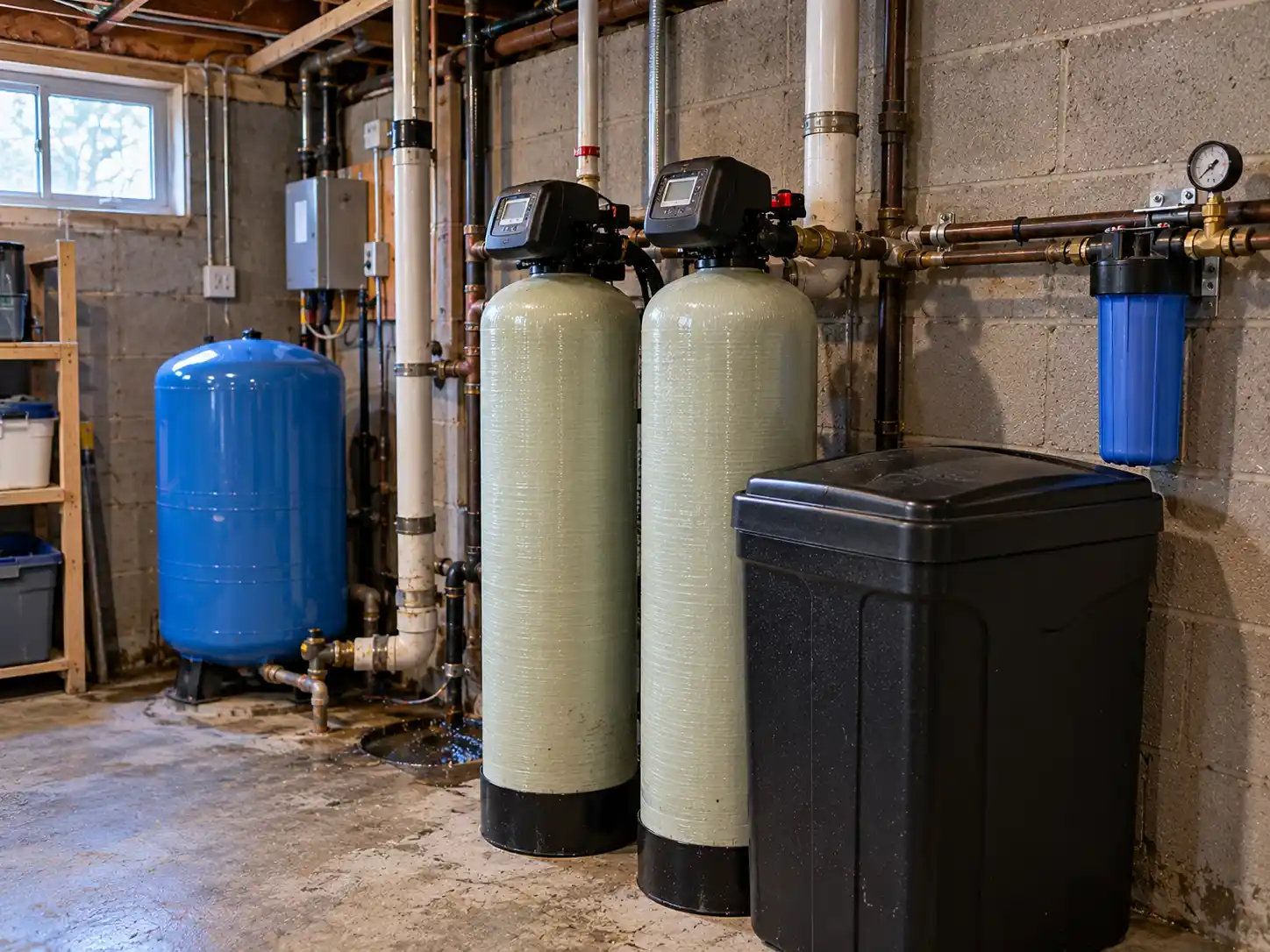
That's why the typical rural setup here is a chain, not a single tank: a dedicated iron filter for well water first, which also strips sulphur odour; then the well water softener to remove hardness; then a UV disinfection unit as the final barrier against bacteria, which no softener or filter addresses. We design the chain around your lab results, install it in the right order after the pressure tank, and make sure your well pump and pressure tank can keep up with the backwash flow the filters need. On a property near Belfountain last spring, the owners had replaced a softener twice in six years before anyone tested for iron; a proper iron filter ahead of the new softener finally solved it.
Orange stains, sulphur smell, or a softener that keeps dying? Call (289) 236-7045 — we'll test the well and design the right treatment chain.
Rent or Buy a Water Softener? The Ontario Question
Many Caledon homes come with a rented softener already in the basement, and the monthly charge quietly follows the house from owner to owner. Renting isn't wrong — but it's worth doing the math before you sign or renew. Here's how we lay it out for homeowners.
Renting can make sense when…
You plan to move within a couple of years
You'd rather avoid any upfront cost right now
The contract clearly includes repairs and parts
You've read the buyout and cancellation terms and are comfortable with them
Owning is usually the better move when…
You're staying put — rental fees typically outrun the purchase price within a few years
You want the unit sized and set up for your actual water, not a one-size rental model
You're on a well and need an iron filter or UV added — rentals rarely cover a full chain
You don't want a rental contract complicating a future home sale
If you've just bought a home with a rented unit, check the contract for the buyout figure before it auto-renews — we're happy to look at the existing softener and tell you whether it's worth buying out, or whether a new owned system makes more sense for your water.
Why Caledon Homeowners Trust ProFlow for Water Softeners
Water treatment dealers sell equipment; plumbers understand what hard water does to the rest of your house. We do both. Our licensed technicians test before they recommend, install softeners and filters to plumbing code, and are the same people you'd call when a water heater fails or a well pump quits — so the whole system gets looked at together, not in pieces.
Water tested on site before any recommendation
Upfront, flat pricing — the quote is the invoice
Municipal and well water systems, including iron & UV
Licensed local plumbers, clean respectful work
Water Softeners in Caledon - Frequently Asked Questions
How hard is the water in Caledon?
Caledon's water ranges from hard to very hard depending on where you live. Peel Region's 2025 reports show about 120–130 mg/L (7–7.6 gpg) in Bolton, 190–280 mg/L in Caledon Village, 240–250 mg/L in Palgrave, and 280–360 mg/L (up to 21 gpg) in Caledon East and Alton. Anything over 180 mg/L is classed as very hard, and private wells are often higher again.
Do I really need a water softener in Caledon?
Whether you need a water softener in Caledon depends on your tolerance for scale, but for most homes outside Bolton the answer is yes. At 200–360 mg/L, hardness shortens the life of water heaters, dishwashers, and faucet cartridges, and raises soap and energy use. A softener is the one piece of hard water treatment that protects everything downstream at once.
Is it better to rent or buy a water softener in Ontario?
Renting or buying a water softener in Ontario comes down to how long you're staying. Rental fees run indefinitely and usually add up to more than the price of an owned unit within a few years, and rental contracts can complicate a home sale. Renting suits short-term owners who want zero upfront cost; owning suits anyone staying put or on a well who needs a properly sized system with iron filtration.
Will a water softener remove iron and the sulphur smell from my well water?
A water softener alone won't reliably remove iron or the sulphur smell from well water. It can catch trace iron, but heavier iron fouls the resin and shortens the softener's life, and hydrogen sulphide passes straight through. For Caledon wells we install a dedicated iron filter ahead of the softener, which handles both the staining and the odour, and add UV disinfection as the final step for bacteria.
My softener is running but the water is hard again — what's wrong?
A softener that's running but leaving the water hard usually has one of a few faults: a salt bridge or crust in the brine tank, a control valve that isn't drawing brine, a bypass accidentally left open, or resin that's worn out or iron-fouled. Most of these are repairable in one visit; if the resin is spent on an older unit, we'll tell you whether replacement is the smarter spend.
How often does a water softener need service?
A water softener should be serviced about once a year. Between visits, keep the brine tank at least a third full of salt and break up any crust you see. At the annual visit we re-test hardness, clean the brine tank and injector, check for leaks, and on well systems treat the resin for iron — a short appointment that keeps the unit efficient and protects your water heater and fixtures.
What Caledon Homeowners Say About Our Water Softener Service
Natalie F.
★★★★★
We moved to Caledon East last fall and couldn't believe the scale on everything. ProFlow tested the water, showed us the numbers, and installed a softener the following week. Shower glass finally stays clear.
2026-01-22
Graham P.
★★★★★
Our well water in Belfountain stained everything orange and smelled like eggs. They put in an iron filter, softener, and UV, in that order, and explained why. Water's been perfect since. Worth every penny.
2026-02-14
Simone R.
★★★★★
Searched 'water softener repair near me' when ours stopped working. Turned out to be a salt bridge and a stuck float — fixed in under an hour, no upsell. Honest service in Bolton.
2026-03-09
Derek L.
★★★★★
We'd been paying rental on a softener for years in Palgrave. ProFlow walked us through buying out versus a new owned unit — no pressure either way. Went with new, properly sized this time, and the difference is obvious.
2026-04-03
Jas K.
★★★★★
Second water heater in eight years and I finally asked why. The tech tested our Alton water, explained the hardness, and installed a softener the same visit as the new tank. Should have done this years ago.
2026-05-18
Colleen M.
★★★★★
Annual service on our softener out on a rural lot near Terra Cotta. They cleaned the brine tank, treated the resin for iron, and re-tested before leaving. Quick, tidy, and they actually explained what they were doing.
2026-06-25
Omar H.
★★★★★
Our softener got stuck regenerating and ran to the drain all night — on a well, that's a scary sound. Called the plumber near me who'd done our well pump before. ProFlow came out same day, replaced the valve, and checked the pump too.
2026-08-12
Elena V.
★★★★★
New build in Southfields Village, no softener included. ProFlow installed one with a bypass and a hard-water tap for the garden. Clean install, upfront quote matched the invoice. Highly recommend.
2026-09-29
Tired of Scale, Stains & Stiff Laundry? Let's Fix the Water.
From a first softener install to a repair on a unit that quit, or a full iron-filter-and-UV chain for a rural well, our licensed Caledon team tests your water, explains the results, and quotes the job upfront.